
Lacrimosa Radiophonica: Requiem for our FM Frequencies
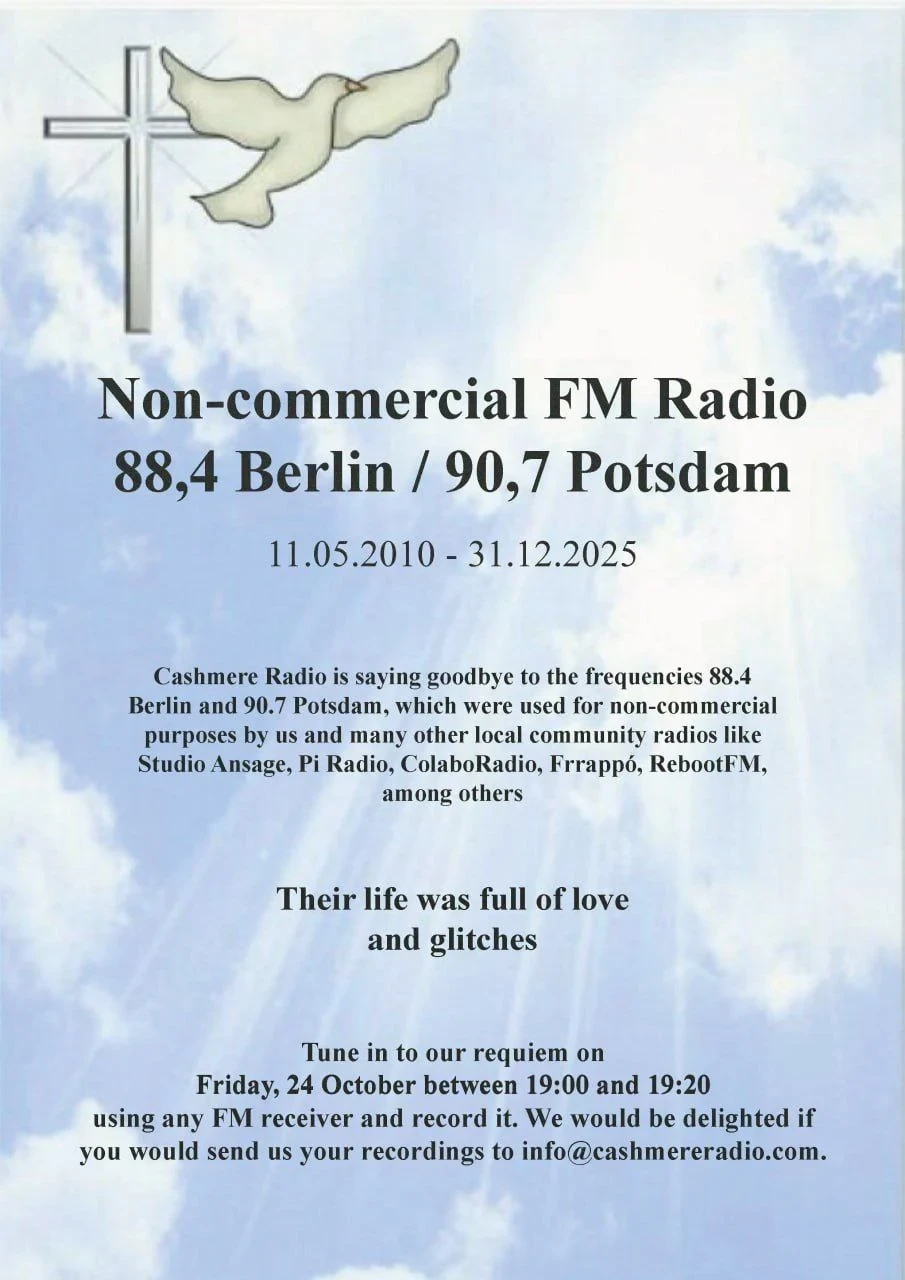
At Cashmere we have been broadcasting weekly on FM frequencies 88,4 Berlin and 90,7 Potsdam as part of the Radionetzwerk Berlin since 2019. This has been a unique space in the local radio landscape: free FM airtime for strictly non-commercial radios providing a diverse choice of radio for listeners and giving room for non-institutional programming, experimentation and multilinguism. These shared frequencies were established in 2010 by mabb (Media Authorities Berlin-Brandenburg) and have since been used by many different local community radios (including Studio Ansage, Pi Radio, ColaboRadio, Frappó, reboot.fm, SAVVYZAAR etc). At Cashmere, we decided that our FM slot should reflect what we produce during the week—our live days, special broadcasts, and the full range of sounds moving through the station. The broadcasts have always been a mix of the newest shows, live specials, and jingles, curated by our FM Rotation Group and offered to a broad section of ‘non-internet’ listeners across Berlin and Potsdam.
Earlier this year, however, the responsible licensing authority (mabb) announced that the FM licence would be put to tender or sold (circa 40,000 Euros/year) communicate to us as part of a Zwischennutzung plan (‘in-between use’) to make the frequencies available long term for military/state purposes. The official statement from the mabb director claimed that the reason for this move was “to ensure media diversity in Berlin and the state of Brandenburg” and further “to continue to advance the digital transformation of the radio market”. Consequently two private radios (the commercial Jazz FM and internet radio Byte FM) who have the resources to pay have acquired the licences and frequencies for the next seven years. This means that Cashmere’s licence will expire on 31 December 2025, and we will no longer broadcast on FM (though we will, of course, continue on DAB+ and webstream). Of course the question remains as to how removing a diverse group of independent community radios from the FM frequencies in any way increases ‘diversity’ of the radio programming? It shows a complete lack of cultural understanding and preoccupation with market concerns.
RIP free FM radio for community radios :(
Despite this change of events, mabb announced an open call to receive funding to produce jingles informing listeners about the transition off FM and our continued presence on DAB+. Of course, there is somewhat an irony here where the institution who executes offers money to essentially “fund your own funeral” (as such)…But this fuelled even more the enthusiasm to realise our proposal and produce jingles and info spots (one short and one long) based on a musical ‘Requiem’ performed in memoriam of our FM frequencies. We also designed the spots so that the other stations leaving FM could use them as well.
And so, on 24.10.25 at 19:00—intended as both homage and critical statement—our sung Requiem for 88,4 / 90,7 was performed and broadcast live on FM by a duo of solemn Cashmere hosts, leading the station and its listeners in remembrance. The team conceived the sonic materiality of FM broadcasting as a compositional tool: using the frequency itself as a real-time delay pedal, a vocal filter, and a dynamic instrument across various recording locations. The strengths of the atena signals played a role in this: the FM signal of the 88,4 Berlin is very weak as the antenna (35m) is in Schöneberg at Winterfeldstr. 21 and it reaches only the surrounding areas: Schöneberg, Charlottenburg, Wilmersdorf und Kreuzberg. In Mitte in the ‘center’ of Berlin, it is already hard to tune in and In Wedding/Gesundbrunnen (where Cashmere Radio Studio is located) almost impossible. The 90,7 Potsdam signal is stronger as the antenna at Fernmeldeturm Berlin-Schäferberg is much higher (103m) and so offers an opportunity for clearer signal. It should be noted that the strength of the signal is also affected by the lack of investment and maintenance undertaken by mabb over the last decades, prioritising the premium frequencies for commercial sale and giving the lower quality weak signals (also only in mono) to non-commercial use.
An integral component of the production, then, was the recording and documentation of the requiem itself exposing these factors: the broadcasts were received on car radios, handheld radios, and domestic radios, and recorded simultaneously in different locations across the city (take a listen to one of the recordings here). We deliberately sought out places where reception is typically disrupted—around Alexanderplatz or near our studio in Koloniestraße—so that the interference became part of the material. The resulting recordings, filled with noise, crackling, and momentary signal collapse, became the raw source for the info spots and jingles. These combine atmospheric fragments of fading, struggling voices with an upbeat narrative voice-over explaining new digital listening options such as DAB+. Our hope is that these small interventions will help listeners stay tuned to Cashmere and to the other stations in the Radionetzwerk. But they also mark a moment to acknowledge the wider concern for free independent FM radio in Berlin, a landscape we have been grateful to be part of.
Within the wider landscape of independent community radio, this shift signals something larger: the steady disappearance of non-commercial FM space from the public domain. The reallocation of these frequencies—once designed to serve community broadcasters—reflects an institutional logic that increasingly favours commercial actors and measurable ‘impact’ and ‘professionalisation’ over cultural plurality, accessibility, and experimentation. For those of us in ICRN, this is a familiar trajectory: city and regional authorities turning toward market-based rationales, while independent stations are expected to adapt, digitise, or disappear. What is lost is more than coverage—it is a form of public cultural infrastructure that allows diverse communities to inhabit the spectrum on their own terms. The loss of Cashmere’s and the other stations of the Netzwerk’s FM presence thus stands as a reminder that cultural ecosystems fail not through dramatic acts of destruction but through the slow erosion of the spaces that allow alternative voices to be heard at all. It becomes part of a broader story of how quickly the commons can deplete unless we actively defend them and that we must work together in doing so.