
Grinning in the face of guaranteed disappointment
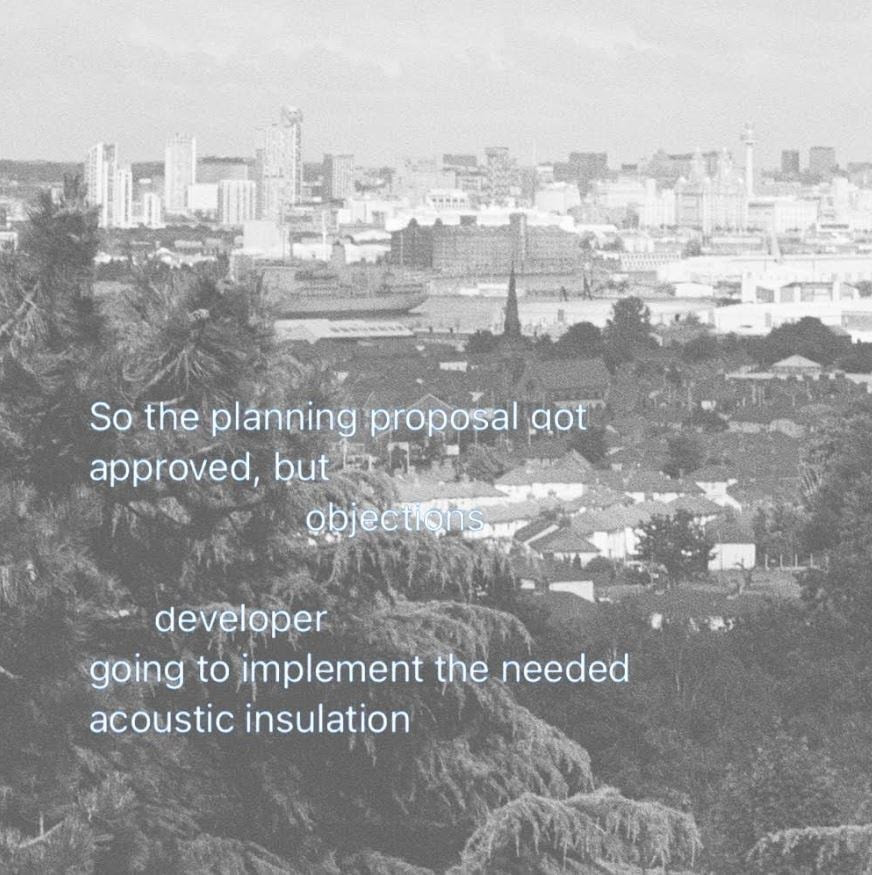
Drawing on experiences in Liverpool between 2015 and 2023, this text examines how neoliberal urban development, regulatory frameworks and property speculation contributed to the erosion of grassroots cultural infrastructure, including spaces such as Melodic Distraction Radio and other independent venues. Beyond documenting structural pressures, it reflects on the affective consequences of these processes and argues for renewed cooperation and value-based cultural organising as a response.
In periods of loss, I believe that one of the greatest challenges for culturally active people (artists, venues, arts organisers), is maintaining a sense of hope and purpose. With that in mind, I would argue that when faced with venue closures, censorship and shrinking pools of resources, the most substantial challenge facing the groups affected by these things is a sense of despair.
Such despair is the downstream impact of extractive, neoliberal political economies. Like mould on the walls of a home, this despair causes structural damage to cultural scenes while being cultivated by ambient factors in the environment. Just as mould occurs as the result of cold air, moisture and warm air coming into contacted in an unheated and enclosed space, apathy and a sense of defeat emerge from quite specific contexts.
Between 2015 - 2023, I wrote for and hosted a radio show on Melodic Distraction Radio (MDR) in Liverpool. In 2015, Liverpool’s culture and music scene was in the ascendant. 7 years before, in 2008, the city had been European City of Culture and the material benefits of that were still trickling in. Jurgen Klopp had just taken over as Liverpool manager and the city’s predominant sporting interest had a new lease of life. Most of interest to me, within the Baltic Triangle area of the city, a number of old shipping warehouses were being converted into music venues, artistic studios and cultural spaces.
By the time I was leaving Liverpool in 2022, many of the new creative forces which had been freed within the city were diminishing. Some of the venues which had been opened in this period, such as Constellations, had closed. Others, such as 24 Kitchen Street, lived on in the shadow of new blocks of rental accommodation. During this 2015-2023 period, Melodic Distraction Radio moved twice. Firstly, from its home in the Baltic Triangle to a temporary studio at Jacaranda on Seel Street. Then a second move to a would-be permanent home in Liverpool’s Fabric District. Ultimately, the station closed for a confluence of reasons in 2023.
Witnessing the emergence and decline of a grassroots cultural wave first-hand, its easy to lament these events as a special kind of loss. The reality is that the processes making city neighbourhoods become firstly culturally then economically commodified are well documented. In nearby Manchester, apartments have held the name and location of the famous Haçienda for years. Numerous films, books and media programmes have built on the status of the Haçienda nightclub to give it a near-mythological status within British cultural canon. Playing up the fact that it was fatally unprofitable and at times unpopular only seems to build on this mythos.
That 8 year period in Liverpool always seemed to be on the cusp of being something landmark and remarkable. In hindsight, the most remarkable thing about it was how quickly the rush of new energy pouring through the city was stopped short. One venue which emerged in this period, Constellations, opened in 2014 and was demolished in 2021. With brilliant efficiency, market forces converted a wave of raw creative energy in the city into profit, while simultaneously extinguishing that energy by putting the material resources which catalysed it out of reach.
These spatial changes in the emerging neighborhood were down to a few general causes. Firstly, the influx of developers with cash to burn drives prices up for everyone else. Secondly, landlords will gladly cash in and sell the once-vacant site they were sitting on to a developer aiming to move in. Thirdly, without agent of change planning regulations in place locally, developers could build next door to a nightclub without any onus for sound protection. The net result of this is an influx of noise complaints on the pre existing venue.
The conditions for the market-based breakdown of the Baltic Triangle’s cultural vibrancy can be spelled out in UK and local government policy. Firstly, during the last ten years UK government building policies have incentivised developers to build Purpose Built Student Accommodation (PBSA) and build-to-rent apartments. One such is the Structural and Building Allowance (SBA), introduced in 2018. This enables commercial building owners to claim tax relief on any non-residential capital fixtures within buildings. These capital allowances are available for large apartment and accommodation blocks (which have large non-residential fixtures such as gyms, lifts and stairwells) in a way that developments of individual houses do not.
While this Capital Allowance benefit is essentially a loop hole, there are other policies which have funnelled developers into building Purpose Built Student Accommodation and away from other types of building. In 2022, the UK government introduced the “Residential Property Developer Tax”, a measure designed to recoup funds needed to subsidise the removal of flammable cladding from residential apartment blocks. Aimed to avoid repeating the negligent tragedy which led to the Grenfell Tower fire, this measure excludes taxation of Purpose Built Student Accommodation, along with a number of other communal residential developments such as nursing homes, nunneries and monasteries.
Newer measures have alienated developers and landlords away from typical residential developments too. The Renters’ Rights Act 2025 is designed to protect tenants from exploitative landlord practices. This legislation doesn’t reinvent the UK rental market but it does expand the statutory protections for residential tenants. Similar to the Residential Property Developer Tax, student letting contracts are exempt from the new raft of protections. By extension, students renting in PBSA cannot benefit of the new protections from tenants.
In their early stages, these staggered legislative changes were underpinned by a combustible Local government. In 2021, Liverpool’s Mayor was arrested by local police on charges of suspicion to commit bribery and witness intimidation. In the immediate aftermath, the UK government assumed control of the city’s planning and regeneration departments. There is little public clarity at this stage how this played into development policy implementation within the city, but with trial pending 2026, it is clear that the council operated with a lack of scrutiny in a number of their practices around property.
These elements had a large part to play in stifling the emerging cultural grassroots in Liverpool between 2015-2023. It’s hard to accept that this is the entire story though. To chalk this up completely to “market” based forces, strips the musicians, venues and organisers who brought fresh energy to the city of agency. While these things were happening, it was pretty apparent to culturally active people around the city that venues were closing and development had a hand in that. Sometimes it’s not just a case of venues closing either, sometimes the things people are passionate about stop making money and the vision must become something that’s no longer related to that passion.
It’s easy with hindsight to analyse the people that were active in this period, the decisions they made and question why people didn’t resist in a more organised fashion. In addition to the creative energy around the city at that time, I would say there was a strong entrepreneurial sensibility too. So while venues, musicians and organisers all worked hard to use legal and PR means to challenge these circumstances, without a framework for cooperation they were operating as monads. During this period Melodic Distraction Radio moved twice, and to their credit the team there did so with much grace and minimal bitterness.
Community radio, music and culture generally are all contingent on the material situations such as the one outlined here. While an understanding of the interplay between the political economy of these things requires clever analysis, the character of music and sound seldom corresponds precisely with the dense political environment from which it emerges.
When embarking on any back of house cultural work, the work invariably becomes removed from the end results of nourishing humans with music, or something else which strengthens the heart. Then, when this work is under threat from hostile political or economic circumstances, it is logical that this struggle itself becomes the focus. If we lose that struggle, we might then find ourselves in a jam where the passion which brought us to the world of culture in the first place no longer shines and becomes jaded with cynicism.
Dedicating oneself to the struggle by working toward tangible cooperation between culturally minded individuals and organisations is an admirable endeavour. Yet, what is it in service to? The cruellest thing about adverse circumstances in cultural scenes is that it challenges the ability of those cultural scenes to retain consciousness of what it is that they are standing for.
For me, the sense of connection, presence and belonging that music can establish is second to none. If live music is your thing, compound that with a sense of togetherness and liveness. These are things worth persevering for. The advantage that artists and cultural organisers have is that their source of strength is intrinsically abundant. I am proposing that this source is something that can’t be touched, where good music and art come from and that this is something that eludes political or economic oppression.
While this is essentially a faith based proposition, there are few things more worthy of making oneself of service to than cultivating fallow ground for people to make and enjoy sounds together. As political and economic pressures increase, the ability to access to these essential things is made to feel increasingly utopian.
When I left Liverpool a friend of a friend was quoted to me as having said, “...these things move in ten year cycles in this city, it was the same feeling when State closed…”. In Liverpool today, there are venues like Quarry and club nights like Red City maintaining the same dedication to independent alternative culture as ten years ago. Even if the venues close, that doesn’t mean the people who went there close too.
Aiden Brady is an artist currently based in Newry, Northern Ireland. Aiden currently sits on Dublin Digital Radio's steering committee. His artistic work mainly uses sound, video and digital media to ask questions about the self and the material conditions which shape it.