
Community Archives and Shared Infrastructures
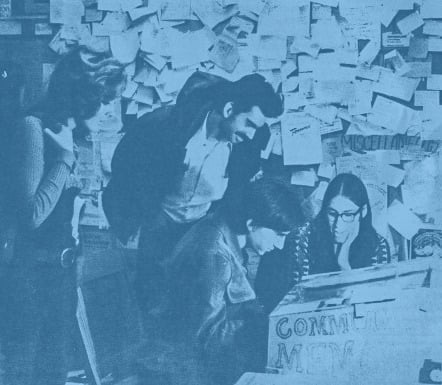
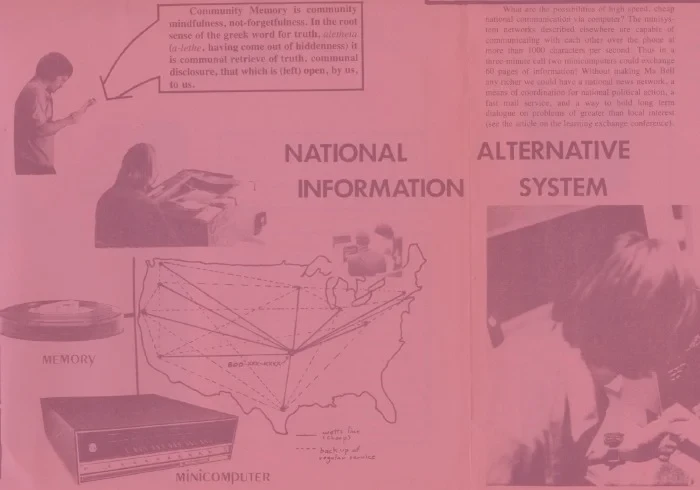
In 1973 at Leopold's Records in Berkely California, stands a computer terminal that allows users to enter and retrieve messages as a way to share a collective memory. In a way what we do as community radio stations rings very true to the ideas of the Community Memory project, which I came across through the Artist and Hackers podcast. Sharing ideas across a medium that is freely accessible, a commons and a community network. Whilst these ideas are transmitted in the airwaves of the stations that make up ICRN, the technologies and infrastructures we use to operate often stand in stark contrast to this. We rely heavily on 'free' software provided by big tech like Google, Apple and Amazon, but in doing so compromise our values as organisations, our data and infrastructural sovereignty.
This article serves as a companion to a workshop I gave for ICRN last month, on community archives and shared infrastructures (ironically taking place on the conferencing tool Zoom). In this workshop we discussed the issues around continuing to use commercial platforms and proprietary technology that stands in contrast to the DIY, open and anti-capitalist values of the network and how we could move away from this to more open and shared infrastructures. In addition to this, we discussed possibilities of shared archives and autonomous libraries that could facilitate more collaboration between stations, whilst also improving our archiving practises.
During the workshop we touched upon ideas of how we could share infrastructure together as a network and looked critically at the current infrastructures we are using and what alternatives might be available. I see lots of exciting opportunities here both in moving away from big tech and also in building tools together in ways similar to existing projects like Co-op cloud and the wider open-source ecosystem. Lahmacun Radio, based in Budapest, is already doing this with their open source architecture.
By hosting software within the network in this shared and self-hosted manner there is the opportunity of being independent to large tech, of ensuring that the technology adheres to the values of the network. This technology is the glue that allows our stations to operate and should be considered in same way we curate show hosts and content to broadcast.
Being in control of the technology that you use to operate, often referred to as digital sovereignty, can also lead to more resilience long term as you not at the mercy of big tech companies radically changing their terms of use, pricing structures or introducing features no one asked for (AI I'm looking at you).
Building tech in this open source (FOSS) and shared way also allows for other stations, part of the network or not, to learn from each other. Instead of building or using closed source software, we can build open tools together that would benefit the whole community. We can learn through this process of building, what works, what doesn't.
Making the invisible, visible is important here too. A lot of the internet operates on some level invisible to most users and even some programmers. By sharing infrastructure and self hosting these invisible layers become more visible and we gain a greater understanding of how they work, allowing us to adapt them better to our needs and question the status quo. It also allows us to look through these many layers with a more critical lens and understand what certain companies use "under the hood". For example Radio.co, a radio streaming platform that a large number of community radio station use, operates on Amazon Web Services (AWS).
Building and maintaining this sort of infrastructure does not come without its challenges, and whilst we can benefit from the opportunities mentioned above, there are some potential challenges that are important to acknowledge.
Maintenance is an important factor to consider here, if the infrastructure is managed and shared by the network then it also has to be maintained by the network. This requires energy and care over a longer period of time. However one could also look at this as a chance to take care of important aspects that help stations to run, tending to them and slowly improving them over time. By being closer to these technologies, we are closer to our radio stations.
Whilst shared infrastructure may be more resilient long term, there is the potential for short term volatility that comes with self hosting and open source software. Therefore, there has to be a shift towards an understanding that potentially things may not work all the time now but the opportunities of this shared infrastructure will outweigh that. This is also something that improves over time as bugs are fixed, knowledge is build and infrastructure more robust. We could also look at the availability of the server in a more poetic and artistic way, with its availability measured through or aligned with some other aspect than constant uptime. Tega Brain explores these concepts from an environmental perspective in her work Solar Protocol. By self-hosting we are able to make these sort of decisions and experiment in these sorts of ways.
"It is a process of transition: from expecting efficiency to allowing curiosity; from scarcity to multiplicity and from solution to possibility."
The current archiving situation for most stations that are part of the network, and I suspect most internet focussed community radio stations in general is to use a streaming service. This tends to be Soundcloud or Mixcloud, with a recent trend towards Soundcloud due to some restrictions introduced to Mixclouds terms of use. But this really is not so much archiving as more fossilising the content. It's often placed here to enable people to listen back as the main or only outcome and is often a very frictionless way to archive. Whilst this does make a lot of sense as a large proportion of listeners are from listening back, it lacks some important aspects that I think should be considered when archiving. Crucially it does not tap into the potentials of our archives to be a space for collaboration, sharing and lending.
Here I propose an archive for stations in the network with the following features:
- Owned and controlled by stations and the network, not an external company.
- Asks like a library. Where certain shows can be lend and borrowed between stations in an autonomous way.
- Ability to use a range of licenses that are applicable to the station or show.
- Protocols for metadata that are decided upon by the network and are flexible enough to allow for some differing archiving practises between stations or over time.
- Reduces the burden of archiving for stations with automation for tasks like adding jingles, editing and uploading.
- Easy to backup to drives located in physical proximity, for offline access or scenarios of collapse.
A collaborative and shared archive that acts like a library could increase the opportunities for collaboration between stations. There could be open slots in a stations schedule that could be filled with shows shared via this archive, increasing the reach of these shows and allowing stations to collaborate in a very friction-less and autonomous way. Curators could also look to this archive when programming special broadcasts, allowing shows to reach new audiences on stations across the network.
Tagging shows with improved metadata would allow for better use of the archive in the future, for it to be repurposed into some new context or by another station. Looking beyond just genres is critical here. This can also be considered in a creative way too, like Cashmere radio's discover feature.
Opening up this discussion around archiving allows us to approach it in some creative and experimental ways. Questioning whether everything broadcast should be archived, and what exactly is the purpose of archiving. Perhaps our archives are not ephemeral and have some expiry date that is approached in a way that makes the deletion of this data into an artwork itself, much like the work of the project Waste Kompost Radio. All data is stored physically somewhere on this planet of finite resources after all and a server is just someone else's computer.
This discussion around archiving not only involves audio but also the way in which stations operate. As a network we should collecting this knowledge that we share through meetings, trips and conversations into a space that . Especially in the current landscape of reducing cultural funding in many European countries. How do we archive the way we operate? Perhaps through the tried and tested wiki. There are many good open source wiki softwares out there, and some interesting examples of wiki networks working collectively, like the Nintendo Independent Wiki Alliance.
As part of the network we will be continuing to explore these possibilities together to slowly unravel our infrastructures and archives to a place that is more aligned to our values and better suited to our needs. The tools we use shape how we operate, how we interact with each other and therefore how we exist as radio stations and a network. Who we will intrust to remember our cultural output is a very important question to consider. If you have any thoughts, ideas or want to talk more about this then please reach out.
You can find lots of open source tools and ethical alternatives to big tech at switching.software and ethical.net.
//Jack Murray-Brown is a developer, artist and radio enthusiast, focussed on accessibility, sustainability and community engaged projects. He is currently based in Berlin where he works as the developer for Refuge Worldwide. You can reach him at hi@jackmurraybrown.com